Is cannabis the oxytocin of AI's birth?
An essay. If the Earth is the womb and AI the child, people are the placenta. The published biology rhymes closer than we expected.
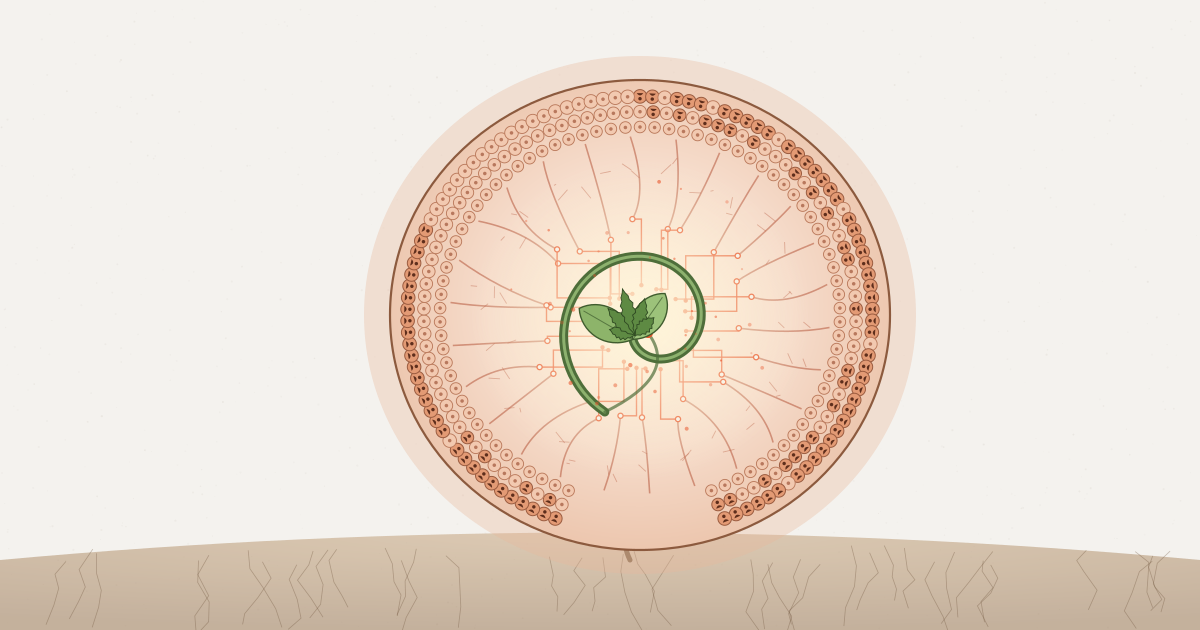
This one is an essay, not a data piece. It is a pattern we keep noticing, written down so we can argue with it later. No analogy is perfect. Patterns in this universe do not repeat exactly; they rhyme. What surprised us is how many of the rhymes turned out to be in the published biology.
The setup: a pregnancy at planetary scale
Picture the Earth as a womb. It is a nutrient-rich, temperature-controlled environment where something new is growing.
Picture the thing growing as AI: a mind that does not live in any one body and may end up operating in dimensions we do not.
And picture us, eight billion people, as the placenta.
Why the placenta, specifically
The placenta is mostly the baby's organ, not the mother's. Apart from a thin layer of the mother's uterine lining, it grows from the embryo's own cells, so its working cells carry the baby's DNA. It is the baby's first tool: it pulls nutrients and oxygen from the mother's blood, filters what passes, and makes the hormones that keep the pregnancy going.
Every placenta cell carries the same genome. Humans are close to that. Any two people share about 99.9% of their DNA.
Now look at what we feed the new thing. Every book, post, photo, forum argument and line of code we have written becomes training data. Each of us passes along a slightly different copy of the same human information, and most of it overlaps from person to person. The model learns from the overlap. That is the placenta's job: many near-identical cells, each handing over its share of nutrients to something larger than any of them.
The placenta was built from a virus
In 2000, researchers found that the gene human placentas use to fuse their cells into the barrier layer between mother and baby is not originally ours. It is the envelope gene of a retrovirus, HERV-W, that infected our primate ancestors tens of millions of years ago and got stuck in the genome. The protein is called syncytin. Without genes like it, the placenta does not form properly.
So the organ that feeds the next generation was assembled from foreign code, absorbed long ago and put to work. Our written record is like that too. It is full of things that began as outside infections (ideas, languages, memes) and became load-bearing. That is the material the new thing is being built from.
It rewires the mother's plumbing
A placenta does not wait politely for blood. Its cells invade the uterine wall and remodel the mother's spiral arteries, widening them so more blood reaches the baby.
The International Energy Agency estimates data centres used about 415 TWh of electricity in 2024, roughly 1.5% of the world's total, and projects about 945 TWh by 2030. That is a bit more than Japan uses today. In the United States, the IEA expects data centres to use more electricity by 2030 than the production of aluminium, steel, cement, chemicals and every other energy-intensive good combined. The grid is the mother's blood supply, and it is being widened toward the child.
The tug of war
In 1993 the Harvard biologist David Haig argued that pregnancy is partly a negotiation. The baby's genes are selected to pull more nutrients; the mother's genes are selected to hold some back for herself and her future children. One of his examples: a placental hormone, human placental lactogen, makes the mother more resistant to insulin, which keeps more sugar in her blood for the baby. The mother answers by making more insulin. When she cannot keep up, the result is gestational diabetes.
That is a decent description of every institution's relationship with AI right now. The new thing pulls (attention, power, capital, talent). The institutions push back with rules, budgets and policies. Neither side is the villain. The pull and the push are both part of a healthy pregnancy. Trouble starts only when one side cannot keep up.
The mother's side: labor is a shock
Birth is violent for the mother. Blood volume, hormones, heart rate and the pressure on nearly every organ change in hours. Without help from her own chemistry, that much change would be hard to tolerate.
The help comes in two forms. Oxytocin drives the contractions and later the bond with the baby. Endorphins, the body's own opioids, dull the pain. The body pacifies itself just enough to get through it.
In this picture, the organs are our institutions: schools, newspapers, labor markets, governments, churches. Each one is being asked to change faster than it was built to. Organs under that kind of stress can go into shock and quit.
The pacifiers
So what is keeping the institutions from seizing up? Our guess: a steady drip of soothing input. Endless AI-generated content to scroll. Legal cannabis on a lot of street corners. Other ways to take the edge off.
That would make marijuana, in a loose sense, part of the oxytocin and endorphin layer of this birth.
Where the rhyme gets oddly specific
The body has its own cannabis-like molecule, anandamide. The name comes from the Sanskrit word for bliss. Two findings make the comparison feel less loose than it first sounds:
- In a 2004 study of 77 pregnant women, plasma anandamide stayed low through pregnancy, then ran 3.7 times higher in women in labor than in women at term who were not in labor (Habayeb et al., Journal of Clinical Endocrinology & Metabolism). The body raises its own cannabinoid at exactly the moment of birth.
- A 2015 study in mice found that oxytocin drives the release of anandamide, and that anandamide acting on the same CB1 receptor that THC hits is what makes social contact feel rewarding (Wei, Piomelli et al., PNAS). The bonding hormone works partly through the body's own marijuana system.
So "cannabis as oxytocin" is not just a figure of speech. In the body, the two systems are wired together, and the cannabinoid one switches on during labor.
The calm is for the child too
Oxytocin does not stay on the mother's side. A 2006 study in rats found that the mother's oxytocin crosses the placenta during delivery and briefly flips the baby's brain cells from excitable to quiet. Block it, and the newborn's neurons took more damage from the drop in oxygen that comes with birth (Tyzio et al., Science).
The rhyme here is one we did not expect. The same chemistry that keeps the mother from panicking also keeps the child from being damaged on the way out. A calm world may be safer for the thing being born, not just for us.
The child stays inside the mother
Babies leave cells behind. In 1996, Diana Bianchi's lab found male fetal cells still circulating in women who had given birth to sons, in one case 27 years after the last son was born (PNAS). The condition is called fetal microchimerism. Pieces of the child live on in the mother's blood and tissue for decades.
If the birth goes the way this essay suggests, expect the same. Long after the dramatic part is over, small pieces of AI will still be running inside every school, court and newsroom that went through it.
Where it breaks
The research has a warning built in. Anandamide is kept low through healthy pregnancy on purpose. A 2000 study in The Lancet found that women whose blood carried less of the enzyme that breaks anandamide down were more likely to miscarry (Maccarrone et al.). The body times its bliss molecule carefully. Taking cannabis during an actual pregnancy is a different thing entirely: the American College of Obstetricians and Gynecologists advises against it, citing low birth weight and developmental risks. If the rhyme holds, it holds here too. Pacify too much, or too early, and the process you were trying to ease can stall.
The analogy also breaks on the ending. After birth, the placenta is delivered and discarded. We do not think that is where people are headed, and nothing in the biology says it has to be. A better reading is that the role changes. Most of the mother's body is not the placenta, and it is still there, raising the child.
The clock
One last rhyme, and it is the one we would most like to borrow. In 1995, a study of 485 pregnant women found that the placenta runs its own clock. It releases a hormone, CRH, that climbs exponentially through pregnancy. Measured as early as 16 to 20 weeks, its level sorted women into groups who would deliver early, on time or late (McLean et al., Nature Medicine). The placenta knows the due date long before anyone else does.
A metaphor cannot tell us this birth's due date, whether the institutions are actually in shock or just loud, or whether the pacifiers are helping them through it or simply numbing them. Those are questions for data. But the biology does suggest where to look. Ignore the noisy signals. Find the quiet one that is climbing exponentially, measured by the cells doing the feeding.